Table Of Content
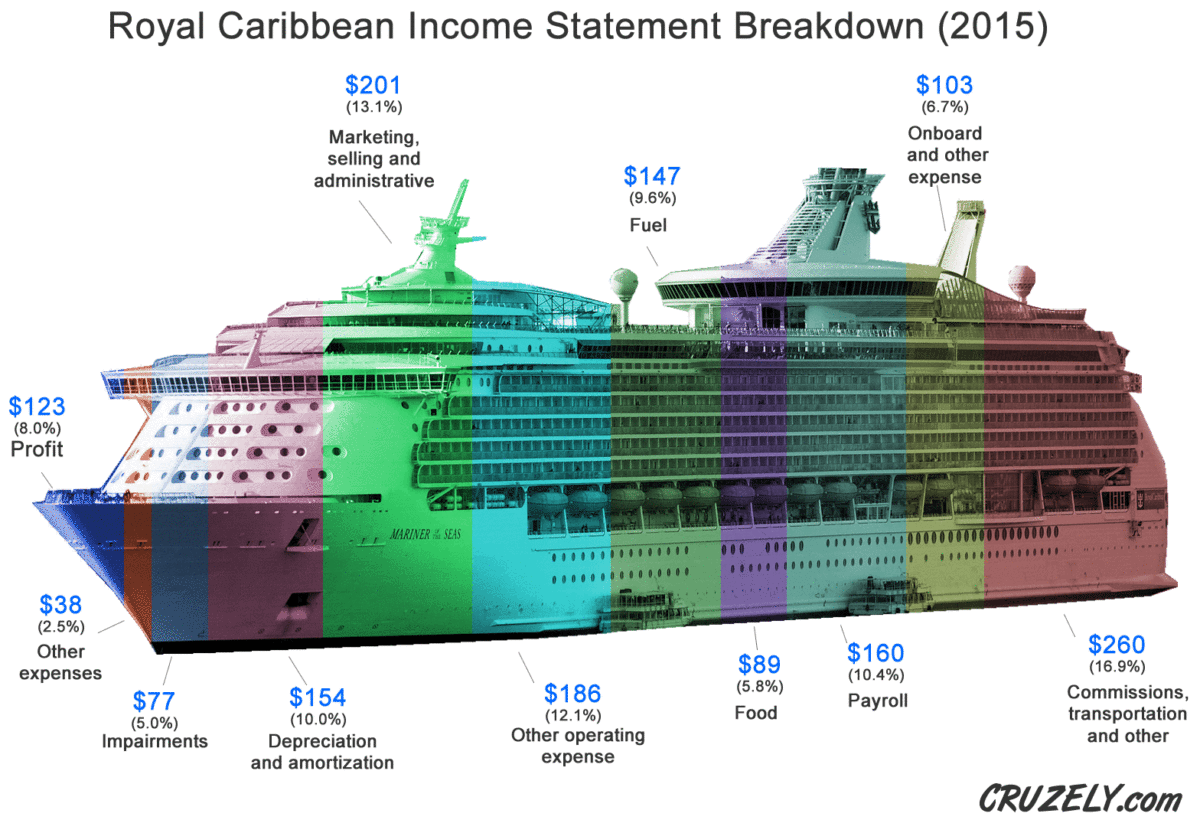
Itineraries that involve longer distances or require the ship to navigate against strong currents can increase fuel usage. Alternatively, routes that take advantage of favorable currents or strategic sailings can help conserve fuel. Cruise lines often analyze various factors, including wind patterns, tidal currents, and sea conditions, to determine the most fuel-efficient routes.
Marine Gas Oil (MGO)
It is a thick, viscous fuel that is derived from crude oil and contains higher levels of sulfur compared to other fuels. While HFO is cheaper than MGO, it also has a higher environmental impact due to its sulfur content. These initiatives aim to reduce air pollution and improve the environmental performance of cruise ships.
Sailing Speed
Shaft generators are also useful in lowering the consumption with the production of electrical power. This removes the auxiliary machinery out of the picture while sailing, reducing the fuel consumption. After the arrival of 0.5%, sulfur content regulation under MARPOL, diesel engines faces significant changes.
Propulsion Types and their Fuels for Cruise Ships
As for smaller machinery (cabin lights, galley equipment), the electricity goes through the transformer and is thus stepped down into lower voltage. They carry power from generators to switchboards, through passageways, public rooms, crew and passenger cabins. If the electrical cables aren't truly redundant, even ships that feature two engine rooms suffer power failure.
How Much Fuel Do Cruise Ships Hold
How Much Oil Is on That Ship? - NOAA Office of Response and Restoration
How Much Oil Is on That Ship?.
Posted: Tue, 08 Mar 2016 08:00:00 GMT [source]
We provide expert advice, insightful reviews, and comprehensive guides to help seasoned and novice cruisers create their ideal sea journeys. Whether you desire adventure, luxury, or exploration, High Seas Cruising is your compass to unforgettable cruise vacations. Smaller cruise ships like Norwegian Spirit or Carnival Elation use around $80,000 of fuel daily. Since bunkering mostly proceeds before the voyage or during port visits, safety remains important.

Bermuda Cruise Port Guide
Taking an average of 40 gallons per knot, the Spirit will use 960 (almost 1,000!) gallons of fuel per hour. There are two important items to keep in mind when calculating how often a cruise ship needs to be refueled. The first is that the average cruise ship will burn between gallons of fuel per nautical mile. The second is that a good-sized barge can hold about 450,000 gallons of fuel to supply to cruise ships. These are rough estimates and actual fuel efficiency can vary based on many factors.
This cruise ship can carry nearly 10,000 people. Here’s more of what sets Icon of the Seas apart - CNN
This cruise ship can carry nearly 10,000 people. Here’s more of what sets Icon of the Seas apart.
Posted: Mon, 29 Jan 2024 08:00:00 GMT [source]
Cruise Ship Engine Power, Propulsion, Fuel
These technologies help remove sulfur and other harmful substances from exhaust gases, resulting in a significant reduction in emissions. Additionally, cruise operators are adopting measures to manage passenger density and optimize energy consumption onboard. The fuel consumption for such ships reduced to 150MT when operating in the eco speed range. Moreover, it goes down further when the vessel is manoeuvring near the visiting ports.
Although it may be hard to fathom this amount of fuel, it makes sense for massive ships that spend days or even weeks at sea. However, the most important factor determining this is the cruise ship’s size. Generally, a large cruise ship up to 1,100 feet in length can carry as much as two million gallons of fuel on board.
Fort Lauderdale-Hollywood International Airport
Compared to the available cargo ships, the draughts of cruise ships vary less. Because of this, the load parameters are dependent less on it and more on the weather. With a relatively higher draught, the propeller performance changes significantly with the shifting sea conditions. If so, reach out to us, and we’ll be happy to share our knowledge with you.
The Promas Lite propulsion future clients, besides passenger ships, are marine vessels like fishing and freighter ships. ABB Azipod propulsion systems have a major impact on the vessel's operating efficiency - reducing energy consumption and bad emissions by up to 20%. Big ships require much power, so they might have more than one emergency generator. Despite that, they don't have the capacity of main generators and engines, don't produce electricity enough to move the ship, and can't supply all the power needed in ports, because of constraints in space. A medium size cruise ship, holding 1 million gallons of fuel, would take about 285 straight hours of fueling to be maxed out! If we do some more math, we can calculate how long it takes to refuel a cruise ship entirely.
In this post, we’ll answer a few common questions about cruise ships and how much fuel they use. Alternative fuels, electrification, advanced energy management systems, and ongoing design and construction innovations will continue to improve fuel efficiency. Collaboration among cruise lines, industry associations, and regulatory bodies will establish industry-wide standards and best practices, driving the industry’s commitment to sustainability. By carefully managing speed and itinerary, cruise lines can strike a balance between passenger comfort and fuel efficiency, ensuring a memorable and eco-friendly experience for travelers. As the industry continues to evolve, there is an ongoing focus on adopting sustainable practices that minimize fuel consumption and environmental impact.
In 2012, TUI used 54,463 tons of fuel, including 9,732 tons LSFO (low sulfur fuel oil), 40,880 tons HFO (heavy fuel oil) and 3,851 tons MDO (marine diesel oil). It is worth noting that the cruise industry is actively working to improve fuel efficiency and reduce gas consumption. As the industry continues to strive towards sustainability, finding innovative ways to optimize gas consumption and reduce emissions on all ship sizes will be a top priority. Ship size and passenger capacity also play a significant role in fuel consumption.
This explains the dynamic stability and also takes up less room for a larger passenger capacity. Thus, the primary function of the settling tank is to primarily separate any water from the regular diesel fuel. To comply with coastal regulations, cruise ships’ general bunkers must be of a high caliber and cost. The Harmony, a Royal Caribbean ship, has two 16-cylinder Wärtsil engines that are four stories high, according to The Guardian. They would consume approximately 66,000 gallons of highly polluting diesel fuel per day when operating at full capacity, or about 1,377 gallons per hour. It’s important to remember that Harmony of the Seas was the largest cruise ship in the world up until the new Symphony of the Seas debuted in 2017.
The Cunard Queen Mary 2, hailed as the world’s fastest cruise ship, has a total fuel capacity of 4,381 metric tonnes. This moves the 151,400-tonne luxury liner forward at a rate of 41 feet for every gallon. This allows her to spend 10 days at sea without refueling at her average speed of 29 knots. If she were traveling at her top speed of 32.5 knots, she would reach her destination faster but would use a lot more fuel. Like driving a car, traveling at higher speeds causes an increase in aerodynamic drag, which has an immediate impact on fuel consumption.
In this article, we will delve into the fascinating world of cruise ship fuel and explore how much fuel these massive ships actually hold. We will examine the factors that affect fuel capacity, the types of fuel used, and how it is stored on board. Additionally, we will discuss the fuel consumption of cruise ships and the environmental impact it has. Finally, we will highlight some measures that the cruise industry is taking to reduce fuel consumption. The fuel consumption of a cruise ship is measured in terms of “gallons per nautical mile” (g/nm). This metric provides an indication of the ship’s fuel efficiency and can vary depending on the ship’s design, technology, and operational factors.
Both self-unloading dry bulk vessels were China-built (by Chengxi Shipyard Co Ltd / subsidiary of CSSC) and scheduled for deliveries in 2021. Main engines and generators require electricity and it's needed to keep them going. Pumps that are driven electrically take in cold ocean water to cool the engines and electrical pumps get fuel from fuel tanks and supply it to the engine. Electrical power is vital for many operational functions - without it, ships come to a halt.




No comments:
Post a Comment